For years, the default Northern Colorado conversation was simple: move to Fort Collins. And listen, Fort Collins is still one of the best places to live in the country. We are still investing there, still helping people relocate there, and still believe it has an incredible lifestyle.
But moving to Loveland is no longer a backup plan for people who cannot make Fort Collins work. In 2026, more buyers are starting their search in Loveland because they see the value, the growth, the location, and the lifestyle.
When we compare the two cities honestly, Loveland is offering a serious combination: lower home prices, more room for growth, proximity to Denver and the mountains, and a downtown and community identity that continues to get stronger. Here are the six big reasons moving to Loveland is gaining traction.
Table of Contents
- Moving to Loveland: The Price Gap Is Real
- Moving to Loveland for Growth and Appreciation Potential
- Why Loveland Is Getting National Recognition
- Moving to Loveland: Why Location Matters
- Loveland Is More Than a Cheaper Alternative to Fort Collins
- Living in Loveland: Small-City Feel With Real Amenities
- Should You Move to Loveland? Start Your Home Search Here
Moving to Loveland: The Price Gap Is Real
First and foremost, the financial difference is meaningful. The rolling 12 month median sales price for attached and detached homes in Fort Collins is about $558,000. In Loveland, it is about $500,000.
That is roughly a 10 percent discount for moving to Loveland, and it is not just a small difference on paper. It can change the kind of home, neighborhood, square footage, lot size, or financial flexibility that buyers get.
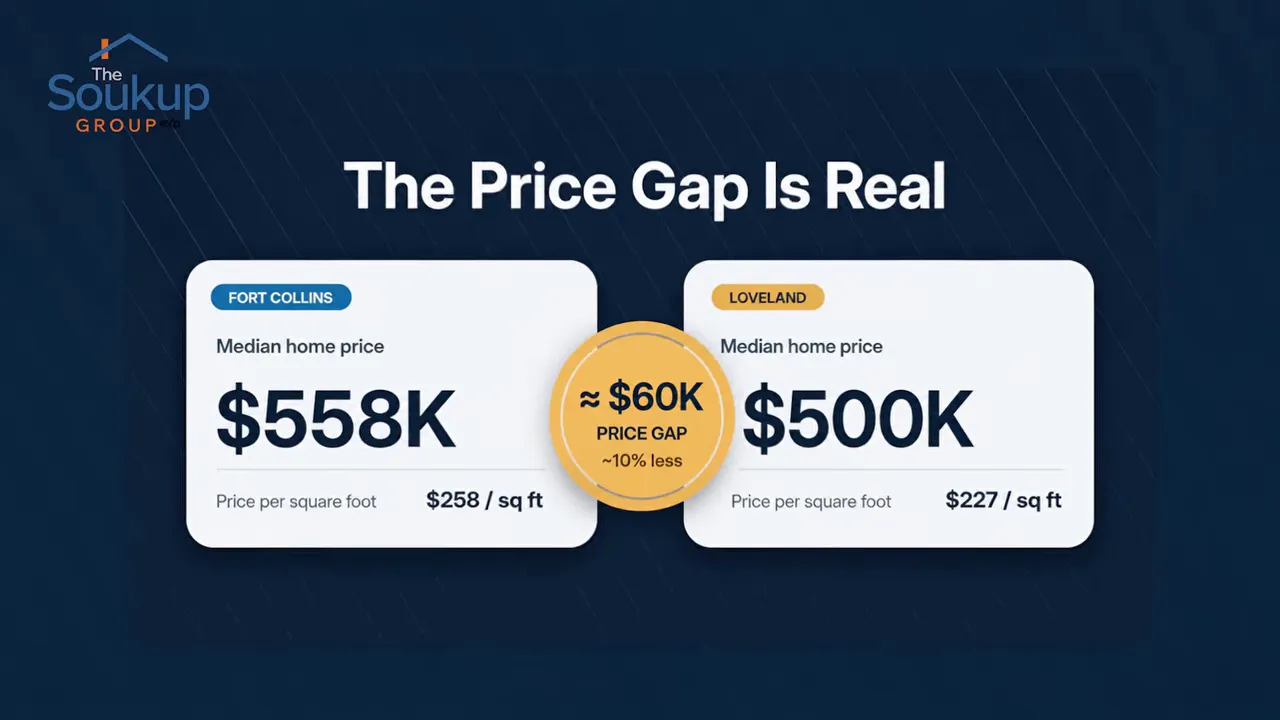
The price per square foot tells a similar story. Fort Collins is around $258 per square foot, compared with approximately $227 per square foot in Loveland. So buyers are often getting a lower purchase price and more house for the money at the same time.
We have seen this firsthand. When we bought our first home in 2012, Loveland was where the budget made sense. The purchase price was $162,000. We put a lot of sweat equity into that house, but today it would likely be worth around $450,000. At the time, Loveland was simply where we could afford to buy. Today, it is where many buyers intentionally want to be.
There is a real address effect in Northern Colorado. A Fort Collins address carries more pricing weight, even in places where the lifestyle and proximity may feel very similar. That creates an opportunity for people who are moving to Loveland and want Northern Colorado living without paying the full Fort Collins premium.
Moving to Loveland for Growth and Appreciation Potential
A more expensive market is not automatically the better long term investment. Fort Collins remains a strong place to own real estate, but Loveland may have more upside because there is so much happening there right now.
The biggest shift is that Loveland is no longer standing still. Downtown redevelopment, new residential communities, retail expansion, sports facilities, airport improvements, and transportation planning are all helping reshape the city.
The Foundry has become a major example of what is changing. It brought a new gathering space, restaurants, retail, housing, and a more active downtown environment near Fourth Street. Meanwhile, Fourth Street improvements and downtown beautification projects are continuing to improve the experience of being in the core of Loveland.
Then there is the Ranch complex. Phase one of its redevelopment includes a reported $100 million investment, with plans for an amphitheater, additional sports facilities, ice rinks, and a major upgrade to this Larimer County destination.
For buyers considering moving to Loveland, it is worth paying attention to infrastructure too. The Northern Colorado Regional Airport is co-owned by Loveland and Fort Collins, but it is located in Loveland. A new terminal is complete, runway work is underway, and the next major objective is securing a physical air traffic control tower. The vision is for more consistent commercial air service, which could bring significant economic activity to the area.
The planned Front Range Passenger Rail is another major future consideration. It is expected to serve both Fort Collins and Loveland, with passenger rail connections toward Denver. Add in new development at Centerra South, Bass Pro Shops, and residential growth throughout the city, and it is clear why moving to Loveland has become an appreciation conversation, not just an affordability conversation.
Why Loveland Is Getting National Recognition
There was a time when Fort Collins seemed to receive all the rankings, all the recognition, and all the attention. That is changing. Loveland was recently ranked number seven among the best places to live in the West, while Fort Collins came in at number four.

Those rankings look at a broad group of factors, including affordability, cost of living, amenities, location, overall quality of life, sunshine, and what we might just call the happiness factor. Loveland checks a lot of those boxes.
Northern Colorado offers roughly 300 days of sunshine, four distinct seasons, access to outdoor recreation, and a lifestyle that balances city convenience with room to breathe. Moving to Loveland allows buyers to tap into that lifestyle while often retaining a better value proposition.
Rankings should never make the decision for us. They are not a substitute for walking neighborhoods, understanding commute patterns, or finding the right home. But they do reflect something we are seeing on the ground: Loveland is getting credit for the lifestyle it has built.
Moving to Loveland: Why Location Matters
Location is where the Loveland conversation gets especially interesting. Fort Collins has a great location, but Loveland may fit certain relocation goals even better.
First, Loveland sits farther south. That gives it a little more buffer from the more Wyoming-like weather that can become more pronounced north of Wellington. Northern Colorado is beautiful, and Wyoming is beautiful, but the wind, blizzards, and highway closures north of Fort Collins can be a real part of life. Loveland still gets snow and changing seasons, but it is a little farther from those weather extremes.
Second, moving to Loveland can reduce the drive south. For people commuting to Denver or Denver International Airport on a regular basis, Loveland can save roughly 15 to 20 minutes compared with Fort Collins. I-25 is the major economic corridor to Denver, and that location difference matters over time.
Third, outdoor access is fantastic. Loveland sits right against the foothills, is about 30 minutes from Estes Park, and roughly 45 minutes from Rocky Mountain National Park. For many people moving to Loveland, that access is not just a nice extra. It is the whole reason for relocating to Colorado.
We get the sunshine, the mountain access, the changing seasons, and a more favorable position for Denver and DIA travel. That is a strong combination.
Loveland Is More Than a Cheaper Alternative to Fort Collins
This is important. Loveland is not simply Fort Collins with a lower price tag. It has created its own identity, and that identity is becoming more defined every year.
Fort Collins has long worked to separate itself from Boulder. It has its own more relaxed, less pretentious personality. Loveland is doing the same thing in relation to Fort Collins. It is building a city where people can live their day-to-day lives without constantly needing to drive north for everything.
People are playing volleyball, participating in local sports, coaching school teams, shopping for groceries, using recreation facilities, and enjoying parks and activities right in Loveland. The Chilson Recreation Center, local athletics, arts, sculpture, outdoor spaces, and community events all contribute to that local character.
Downtown is also giving Loveland a more vibrant, recognizable core. The Foundry, public art, restaurants, retail, and redevelopment make it clear that moving to Loveland means joining a community that is actively becoming more of itself, not more like somebody else.
Yes, buyers may still get that approximate 10 percent price advantage. But the value is not only about being less expensive. It is about getting a community with its own culture, identity, and momentum.
Living in Loveland: Small-City Feel With Real Amenities
Fort Collins has an energy that comes from Colorado State University. We love that energy. But it also means an annual influx of college age residents from late summer through spring. Loveland has a slightly higher median age and a somewhat more relaxed overall feel because it does not have that same university-driven center.
That does not mean it lacks amenities. In fact, Loveland has nearly everything most households need close by:
- Grocery stores, restaurants, movie theaters, and retail
- The Promenade Shops at Centerra and the broader Centerra area
- Major retailers and new additions such as Costco and Bass Pro Shops
- Sports complexes, recreation centers, parks, and outdoor activities
- Easy access to Fort Collins, Denver, CSU events, and pro sports
There will be congestion in certain corridors, especially along U.S. 34 east and west and U.S. 287 north and south. We should be honest about that. But once we get into many of the residential areas and outskirts, the pace can feel substantially more laid-back.

And when we want the buzz of Fort Collins, it is close. CSU football at Canvas Stadium, basketball at Moby Arena, restaurants, and other Fort Collins amenities are generally an easy drive away. Denver pro sports are also within reach. Moving to Loveland can offer that balance of quieter everyday living and nearby regional activity.
Should You Should You Move to Loveland? Start Your Home Search Here Your Search in Loveland?
We are hearing a noticeable change in relocation conversations. In the past, many people would say, “We are moving to Fort Collins,” and Loveland entered the discussion only after looking at prices. Now, more people are saying they want to begin with Loveland and consider Fort Collins as an alternative.
That makes sense for people who want:
- More home for their budget
- Access to a Northern Colorado outdoor lifestyle
- A slightly shorter drive toward Denver or DIA
- Proximity to Estes Park and Rocky Mountain National Park
- A quieter pace without giving up everyday convenience
- A city with visible redevelopment and long term growth potential
Fort Collins is absolutely still an outstanding option. But moving to Loveland deserves to be a first-choice conversation, especially for buyers focused on affordability, access, and future momentum. Fifteen to 20 minutes south of Fort Collins, we can find a meaningful discount while keeping the lifestyle that makes Northern Colorado so attractive.
Before making a final choice, compare neighborhoods, traffic routes, home styles, work commutes, and the places where we expect to spend our time. The right city is not always the one with the biggest name. Sometimes it is the one where the value, lifestyle, and long term vision line up best.
Thinking about moving to Loveland, exploring new construction homes, or relocating to Northern Colorado? I can help you compare communities, neighborhoods, home values, and new construction opportunities so you can find the right fit for your lifestyle and budget. Call or text me at (970) 893-3533 or book your FREE consultation today to discuss your relocation plans and find out what Loveland has to offer.
Frequently Asked Questions About Moving to Loveland
Is moving to Loveland more affordable than moving to Fort Collins?
Based on the rolling 12 month figures discussed here, Loveland had a median home price of about $500,000 compared with about $558,000 in Fort Collins. That is roughly a 10 percent difference, along with a lower average price per square foot in Loveland.
Is Loveland closer to Denver than Fort Collins?
Yes. Moving to Loveland can save roughly 15 to 20 minutes for drives toward Denver or Denver International Airport compared with living in Fort Collins, depending on the exact starting point, destination, and traffic conditions.
Does Loveland have enough amenities for everyday life?
Yes. Loveland has grocery stores, movies, retail, recreation, sports facilities, parks, the Promenade Shops at Centerra, and growing retail options. Fort Collins is also nearby for CSU events and additional dining, entertainment, and services.
Why are buyers interested in moving to Loveland in 2026?
Buyers are drawn to moving to Loveland because of its home price advantage, redevelopment activity, potential airport and rail improvements, location closer to Denver, access to the foothills, distinct community identity, and more laid-back feel.
Read More: FORT COLLINS REAL ESTATE MARKET UPDATE: PRICES RISE AS INVENTORY HITS A 10 YEAR HIGH