
When people start thinking about retiring in Colorado, Fort Collins is not always the first city that comes to mind. We tend to picture mountain resort towns, Denver suburbs, or warm weather retirement communities. But after helping hundreds of households relocate to Northern Colorado, we have seen Fort Collins become a very real retirement destination.
It is not the cheapest place to buy a home, and it is not a classic Florida-style 55-plus resort market. What it does offer is a lifestyle: four genuine seasons, roughly 300 days of sunshine, a strong recreation system, access to the outdoors, a lively downtown, and the chance to build a retirement around family, community, and doing things we actually enjoy.
Table of Contents
- Why Fort Collins Stands Out for Retiring in Colorado
- Who Is Retiring in Colorado and Moving to Fort Collins?
- Fort Collins Housing Costs for Retirees
- Taxes, Utilities, and the Cost of Retiring in Colorado
- Retirement Lifestyle and Recreation in Fort Collins
- Getting Around Fort Collins and Northern Colorado
- Fort Collins Communities, Safety, and 55+ Living
- Is Fort Collins a Good Place for Retiring in Colorado?
Why Fort Collins Stands Out for Retiring in Colorado
For many people, retiring in Colorado is about more than moving somewhere pretty. It is about choosing how we want our days to feel. Fort Collins has a strong mix of sunshine, active outdoor opportunities, city amenities, and a college-town energy that keeps things moving.

We get four seasons here. Summer is sunny and active, fall is gorgeous, spring brings everything back to life, and winter delivers snow without making every day feel gray. There are certainly stretches, especially from mid-January through late February, when we may be ready to snowbird somewhere warmer. That is just being real about it.
Still, the sunshine changes the equation. Fort Collins is not a place where we spend winter staring at clouds for months. For people retiring in Colorado who want seasonal variety without giving up plenty of bright days, that matters.
Who Is Retiring in Colorado and Moving to Fort Collins?
There is not one single retirement profile here. We see a few common stories repeat themselves again and again.
- Parents and grandparents moving closer to family. Many people want to be near their kids and grandkids, whether that means a permanent move, a second home, or spending extended stretches of the year in Northern Colorado.
- Downsizers making a lifestyle move. After the last kid heads to college, a 4,000 or 5,000 square foot house may not make sense anymore. A 2,000 to 2,500 square foot ranch-style home often becomes the target.
- Equity buyers. Some households sell long-held homes in California, Florida, Texas, Arizona, New York, or the Northeast and put that equity into a home here, often with cash.
- Active retirees looking for four seasons. They want trails, golf, restaurants, community events, hiking, and a reason to get outside.
That is why retiring in Colorado can make sense even when the housing prices create sticker shock. The move is often less about getting more square footage and more about buying into a lifestyle we genuinely want to live.

Fort Collins Housing Costs for Retirees
Let us get straight to it: Fort Collins is no longer the value buy it was in the early 2000s or early 2010s. The median price for a single-family detached home is around $620,000. For anyone retiring in Colorado from a lower-cost housing market, that can be a major adjustment.
But the comparison is not always simple. Someone selling an acreage property and a large home in the Midwest might find that the same money buys a smaller lot and smaller house here. That can feel frustrating on paper. Yet many buyers are choosing a manageable home, less maintenance, and a location closer to family or recreation.
The question is not only, “What does the house cost?” It is also, “What does it cost us to live there every year?”
Property Taxes and Insurance
Property taxes can be a meaningful advantage for people relocating from high-tax states. On a $500,000 Fort Collins home, annual property taxes may fall around $2,500 to $3,000. That is dramatically different from paying roughly 3% annually in some other markets.
Insurance has become more expensive. A reasonable planning estimate is roughly 0.5% to 0.6% of property value annually, meaning a $500,000 home could carry an annual premium in the $2,500 to $3,000 range. Actual costs depend on the property, deductible, coverage limits, and insurance carrier, so we should always get current quotes.
HOAs Need a Close Look
For people retiring in Colorado and considering an attached home, townhome, or low-maintenance neighborhood, HOA dues matter. We need to look beyond the monthly number and ask what is included.
- Does the HOA only handle architectural review?
- Does it cover landscaping and exterior maintenance?
- Are water, gas, internet, or pool access included?
- Are there amenities that replace costs we would otherwise pay separately?
A higher HOA fee is not automatically bad. It depends on what work, utilities, and amenities it removes from our monthly to-do list.
Taxes, Utilities, and the Cost of Retiring in Colorado
For retirees on a fixed income, taxes can make or break the monthly budget. Colorado has a flat state income tax of about 4.4%, while Fort Collins sales tax is about 8.05%. That sales tax helps support local amenities, parks, climate initiatives, and transportation.
That is part of the tradeoff when retiring in Colorado. Property taxes may be considerably lower than they are in some states, but the sales tax is higher and needs to be considered in day-to-day spending.
Utilities are generally manageable, though water costs have increased. Water is a scarce and important resource in Northern Colorado, and rate increases help fund infrastructure, storage, and supply systems. We should build water into our budget instead of assuming it will remain static.
For internet, Fort Collins has municipal broadband service, with gig-speed service generally around $70 to $80 per month. That is a solid option for staying connected, streaming, remote work, or keeping in touch with family.
On groceries, a family of five can easily spend around $1,500 monthly, but a retired couple will obviously have a different basket. Dining out does not have to be outrageous either. Two people can find a solid meal for under $50, depending on drinks, appetizers, and where they go.
Retirement Lifestyle and Recreation in Fort Collins
This is where Fort Collins absolutely shines. Retiring in Colorado is more appealing when we can fill our calendars without having to drive two hours every time we want something to do.
The city has a deep bench of recreation resources, including the Northside Aztlan Center, the Fort Collins Senior Center, Mulberry Pool, City Park Pool, the Foothills Activity Center, and activities through the Fort Collins Recreator program. There are cost-effective city memberships and programming for adults, families, and seniors.
A major Southeast Community Center is also planned, with a public library, indoor and outdoor pools, activity space, and fitness facilities. The point is that the city invests heavily in giving people places to be active and connected.
Old Town Is More Than a Downtown
Old Town Fort Collins gives us a real place to go. There are local shops, coffee, restaurants, murals, concerts, art events, patios, and an energy that keeps the city from feeling sleepy.

Fort Collins is known for its brewery scene. Coopersmith’s, New Belgium, and Odell are just a few of the recognizable names, and there is no shortage of patios and gathering places. We do not have to drink beer to enjoy the scene. The benefit is having social places that make it easy to meet people and spend time out of the house.
Trails, Hiking, Water, and Pickleball
For active people retiring in Colorado, Fort Collins has an excellent base of local outdoor options. The city has more than 45 miles of paved trails, plus extensive bike infrastructure. E-bikes are becoming a legitimate way for many people to get around town and stay mobile.
Nearby outdoor destinations include Lory State Park, Horsetooth Mountain, Bobcat Ridge, Red Feather Lakes, and Horsetooth Reservoir. At the reservoir, we can fish, boat, swim, and enjoy the foothills. The Poudre River adds rafting, fishing, and tubing depending on the season and flow.
And yes, pickleball has taken off in a big way. Northern Colorado has added facilities, and Fort Collins has allocated funding for a planned 12-court outdoor complex. For anyone retiring in Colorado who wants a social and active hobby, it is hard to ignore how quickly pickleball has become part of the local culture.
Getting Around Fort Collins and Northern Colorado
We need to be honest here: Fort Collins is generally car-dependent. The average commute is around 17 minutes, but the city spreads out. If we want to walk out the front door for coffee, dinner, and errands, living close to downtown will matter a lot.
MAX Transit exists, but public transportation is not the strongest part of the local lifestyle. Most households should plan on needing a car, at least for now. E-bikes can work extremely well during good weather, but snow and 20-degree days limit that option for plenty of us.
There are some future possibilities worth tracking. The proposed Colorado Connector rail project, also called COCO, is presented as a potential Fort Collins-to-Denver connection by 2029, with an estimated 80-minute trip. That could make Denver events, museums, and sports more accessible without driving.
Denver International Airport is roughly 45 minutes to an hour away depending on traffic. That is a major plus for retirees who want to travel, visit family, or simply escape town for a bit during the coldest part of winter.
Fort Collins Communities, Safety, and 55+ Living
Fort Collins is younger in feel than a dedicated retirement community. Colorado State University brings students, sports, performing arts, and a lot of activity. The local median age has risen into the higher 30s, but it is still not a city built exclusively around retirees.
If we want a slower pace and an older demographic, Loveland may be worth comparing. It offers many similar Northern Colorado advantages with a more laid-back feel.
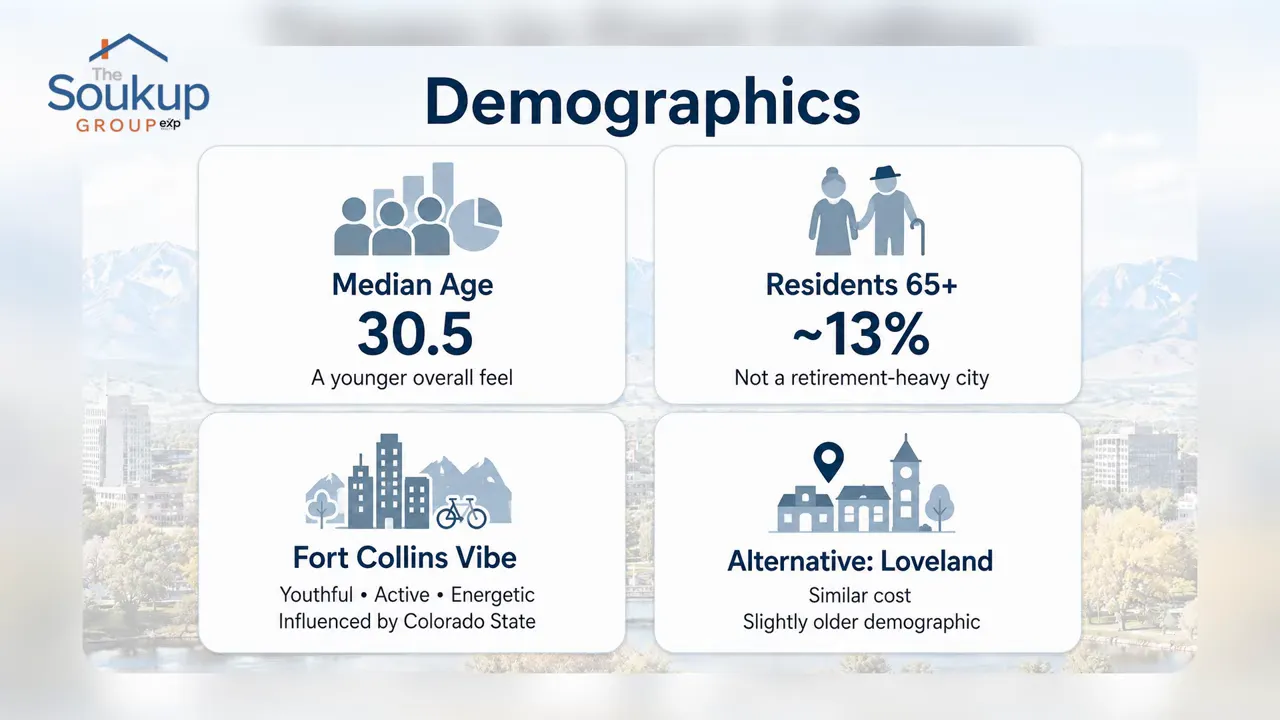
There are not a huge number of 55-plus communities in Fort Collins. This is not a place where every neighborhood is a golf-course resort designed specifically for retirement. But there are residents aging in place throughout the city, golf and tennis opportunities, and communities that people build intentionally through hobbies, clubs, faith communities, recreation centers, and neighborhoods.
Safety is another consideration when retiring in Colorado. Fort Collins generally has low violent crime, while property crime and vehicle-related crime are the more common concerns. Like anywhere, we should use common sense, secure vehicles and belongings, and evaluate the specific neighborhood. Overall, many people feel comfortable spending time in Old Town, Midtown, and other central areas.
Is Fort Collins a Good Place for Retiring in Colorado?
Retiring in Colorado through Fort Collins is not about finding the rock-bottom housing price. It is about deciding whether the overall lifestyle justifies the cost.
For the right household, the answer is absolutely yes. If we are bringing equity from another home, buying with cash, moving closer to children and grandchildren, or looking for a place where we can hike, bike, golf, take classes, meet friends, and enjoy the outdoors, Fort Collins has a lot going for it.
The city gives us a balance that is hard to manufacture elsewhere: outdoor access without living in an isolated mountain town, a real downtown without Denver-scale congestion, a strong recreation system, a university presence, and an airport close enough to keep the rest of the world within reach.
Retiring in Colorado will not look the same for everybody. But if we value quality of life, community, sunshine, and having something to do in every season, Fort Collins deserves a serious place on the shortlist.
If you’re retiring in Colorado and considering Fort Collins for your next chapter, having the right local guidance can make the transition much easier. Whether you’re looking for an existing home, exploring new construction in Fort Collins , or relocating from another state, we can help you compare communities, neighborhoods, home options, and lifestyle factors that matter for retirement.
If you’re considering a relocation to Northern Colorado , let’s talk about what you’re looking for and which areas may be the best fit for your lifestyle and budget.
Call or text (970) 893-3533 or book your FREE consultation today .
Frequently Asked Questions
Is Fort Collins a good place for retiring in Colorado?
Fort Collins can be a strong choice for retirees who prioritize an active lifestyle, access to family, sunshine, trails, restaurants, recreation centers, and four seasons. It is less ideal for those seeking the lowest housing costs or a large concentration of resort-style 55-plus communities.
What is the approximate price of a home in Fort Collins?
The median price for a single-family detached home is around $620,000. Prices vary widely by neighborhood, home type, condition, and proximity to downtown or the foothills.
Are Fort Collins property taxes high?
Property taxes can be comparatively low for people moving from high-tax states. A $500,000 Fort Collins home may have annual property taxes in the approximate $2,500 to $3,000 range.
Can we live in Fort Collins without a car?
Most households will find a car helpful because Fort Collins is spread out and public transit is limited. Living near downtown, using paved trails, and relying on an e-bike can reduce driving needs during favorable weather.
Read More: NORTHERN COLORADO HOUSING MARKET: WHAT BUYERS AND SELLERS NEED TO DO NOW