
If you are relocating to Fort Collins, chances are you have done the late-night Zillow-and-map routine: Where is the good part of town? Which area is actually worth the money? The honest answer is that there is no single winner. The best places to live in Fort Collins depend on the kind of house, daily routine, budget, yard, garage, and long-term plan that fit your life.
To get past the headlines, this guide looks at more than 10 years of detached-home sales across Fort Collins ZIP codes 80521, 80524, 80525, 80526, and 80528. We are talking appreciation, price per square foot, age of homes, new construction, lots, garages, HOA costs, inventory, and how each market held up when interest rates jumped.
The big takeaway right out of the gate: all five areas have appreciated strongly. When relocating to Fort Collins, the costly mistake is not choosing the supposedly wrong ZIP code. It is buying a house that does not fit your actual life, then moving again 18 months later and eating the transaction costs.
Table of Contents
- Fort Collins ZIP Codes and Neighborhoods to Consider
- Why Price Per Square Foot Matters in Fort Collins
- Home Age and New Construction Options
- Lots, HOAs, Garages, and Overall Value
- Fort Collins Market Resilience and Current Inventory
- Relocating to Fort Collins: How to Choose the Right Area
Fort Collins ZIP Codes and Neighborhoods to Consider
Every one of these areas offers a different version of Fort Collins. The house itself tells much of the story.
- 80521, west and northwest: Campus West, City Park, the west side of Old Town, CSU, the Poudre Trail, and foothill access. The median detached home is 1,639 square feet and was built in 1967. This is, by a mile, the oldest and smallest housing stock in the city.
- 80524, north and northeast: Old Town North, the North College corridor, Waterglen, Maple Hill, Saunders, Trailhead, and Country Club Reserve. The median home is 2,584 square feet, built in 2002. It has the broadest housing range, from homes built in 1890 to brand-new construction.
- 80525, south central and southeast: Midtown, the Harmony corridor, Front Range Village, Fossil Creek, Parkwood East, Golden Meadows, Indian Hills, and Huntington Hills. Median home: 2,809 square feet, built in 1988.
- 80526, southwest: Drake, Taft Hill, Horsetooth, Spring Canyon, Cathy Fromme Prairie, Brown Farm, and Rossborough. Median home: 2,314 square feet, built in 1987. This is established Fort Collins pressed right up against foothill and open-space access.
- 80528, southeast: Fossil Lake, Timberline, Fossil Lake Ranch, Harvest Park, Tarmigan, and the area toward Timnath and I-25. Median home: 3,900 square feet, built in 2005. That is about two and a half times the typical size in 80521.
These are not labels for who belongs where. They are simply useful facts about the housing available. When sorting through the best places to live in Fort Collins, this is where you begin: character and walkability, newer construction, central convenience, foothills access, or maximum square footage.
Why Price Per Square Foot Matters in Fort Collins
Median sale price gets all the attention, and it can be wildly misleading. A median price does not strictly measure appreciation. It measures the mix of homes that happened to sell in a given period.
At first glance, 80524 looked like the big appreciation winner from January 2016 through 2026. Its median sale price rose 75.6%, from about $350,000 to $615,000. But bigger, newer houses increasingly entered the sales mix. In 2016, the median home sold there was 2,356 square feet. More recently, it was 2,584 square feet. New construction grew to 16% of sales, and 22% of sales were homes built in the 2020s.
That will pull up the median even if existing homes are not gaining value at the same pace. Meanwhile, 80528 saw builders shift toward slightly smaller plans after rates rose, which pulled the median home size down. Different product mix, different headline, not necessarily different homeowner results.
Price per square foot gives a more honest apples-to-apples comparison. Over the same period:
- 80521 rose 77.3%, from $197 to $349 per square foot.
- 80528 rose 73.3%, from $128 to $223 per square foot.
- 80526 rose 71.6%.
- 80525 rose 70.7%.
- 80524 rose 65.3%.
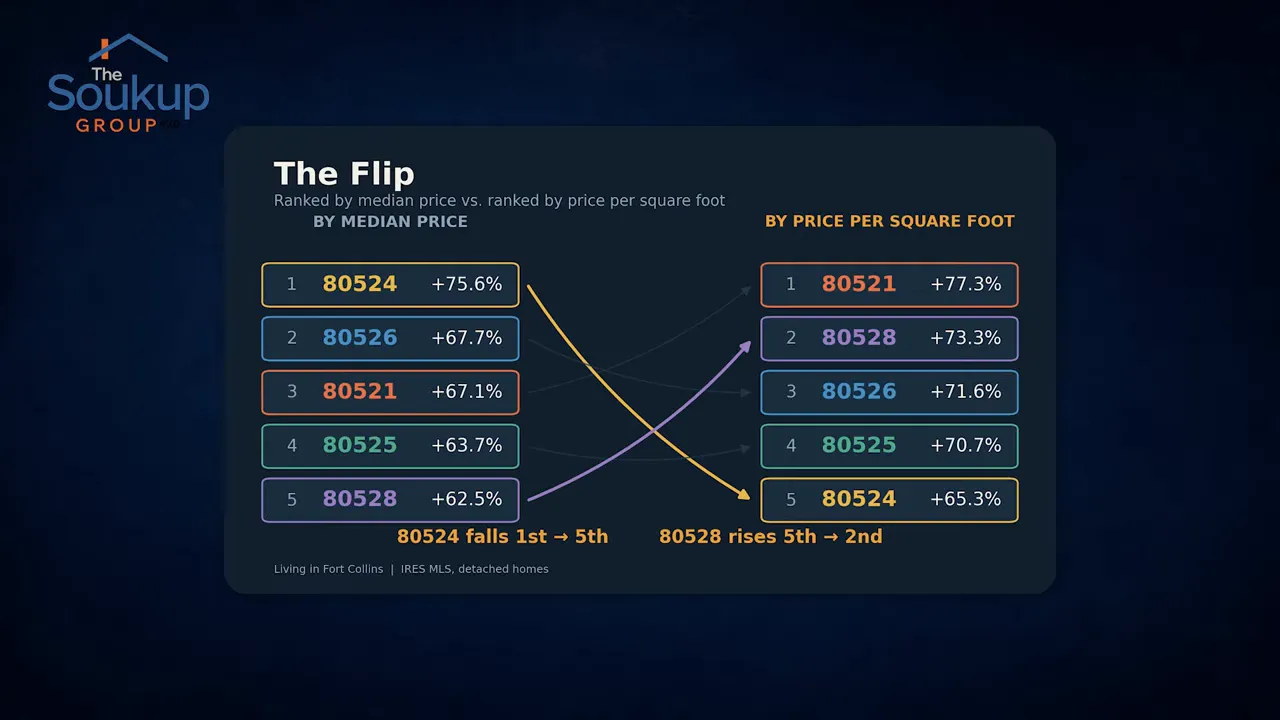
Run the comparison another way, matching spring sales with the same months in 2016, and the order stays basically the same. 80521 is the strongest long-term per-foot performer, while 80524 lands at the bottom after adjusting for size and new-build mix.
Still, do not overreact to a 12-point gap over a decade. Every ZIP code landed between roughly 65% and 77% appreciation per square foot. The Fort Collins tide lifted all five boats. That should take a lot of pressure off the search for the best places to live in Fort Collins.
Home Age and New Construction Options
The actual difference between ZIP codes is not really price. It is what decade the house was built in.
80521: Character, Mature Trees, And Older Homes
In 80521, 71% of detached homes sold were built before 1980, with a median build year of 1967. The oldest sale was from 1894. If a front porch, mature trees, alleys, Old Town access, and real architectural character are high on the list, this is one of the best places to live in Fort Collins for that experience.
Just go in clear-eyed. Older homes have generally been renovated at least once, often twice, and a thorough inspection is non-negotiable.
80526: The Established Eighties And Nineties Sweet Spot
About 63% of 80526 sales were homes built from 1980 through 1999, with a median year of 1987. It is established and landscaped, yet typically modern enough that you are not automatically signing up to rewire the entire house. The newest home sold here was built in 2016, which tells you southwest Fort Collins is substantially built out.
80525: The Balanced Middle
80525 has the most balanced housing mix. It includes older homes, a deep selection from the 1970s through 1990s, plus a meaningful share built since 2000. That variety is a big reason this market has been so steady.
80524 And 80528: Where New Homes Still Exist
80524 is the city’s widest-ranging ZIP code, with 26% of sales from before 1980 and 57% built in 2000 or later. You can find an old Victorian near the north end of Old Town or something framed very recently farther north and northeast.
80528 is the reverse of 80521: just 2% of homes sold were built before 1980, while 77% were built in 2000 or later. For relocating to Fort Collins with a brand-new home as a must-have, the city map gets very small. Inside Fort Collins proper, 80524 and 80528 are the only ZIP codes with meaningful new construction, at 16% and 15% of sales respectively.
80521, 80525, and 80526 were all at zero. That is not a little new construction. That is none. If you want the warranty, fresh finishes, and minimal immediate projects, those are the facts to know before spending months searching in the wrong part of town.
Lots, HOAs, Garages, and Overall Value
On a rolling 12-month average, 80528 is the least expensive area per square foot at $223. Then come 80525 at $237, 80526 at $264, 80524 at $269, and 80521 at $349. A hypothetical 2,000-square-foot home works out to about $698,000 in 80521 versus $445,000 in 80528.
But there are three important asterisks.
- Total versus finished square footage: 80528 has basements in 86% of recent sales, with a median basement around 1,500 square feet. Some of that space is unfinished. Measuring finished area narrows the gap, though 80528 remains less expensive per finished foot than 80521.
- Finishing a basement is not an investment: Finish it because you need the fourth bedroom, room for family, or a spot where the kids can be loud. Do not do it expecting dollar-for-dollar value back. Its real benefit is optionality, giving you room to grow into over time.
- House size and yard size are not the same thing: 80526 has the largest median lot, at 8,722 square feet. 80528 is at 7,923 square feet, despite homes being about 70% larger than those in 80526. Big house, smaller yard is a real tradeoff.
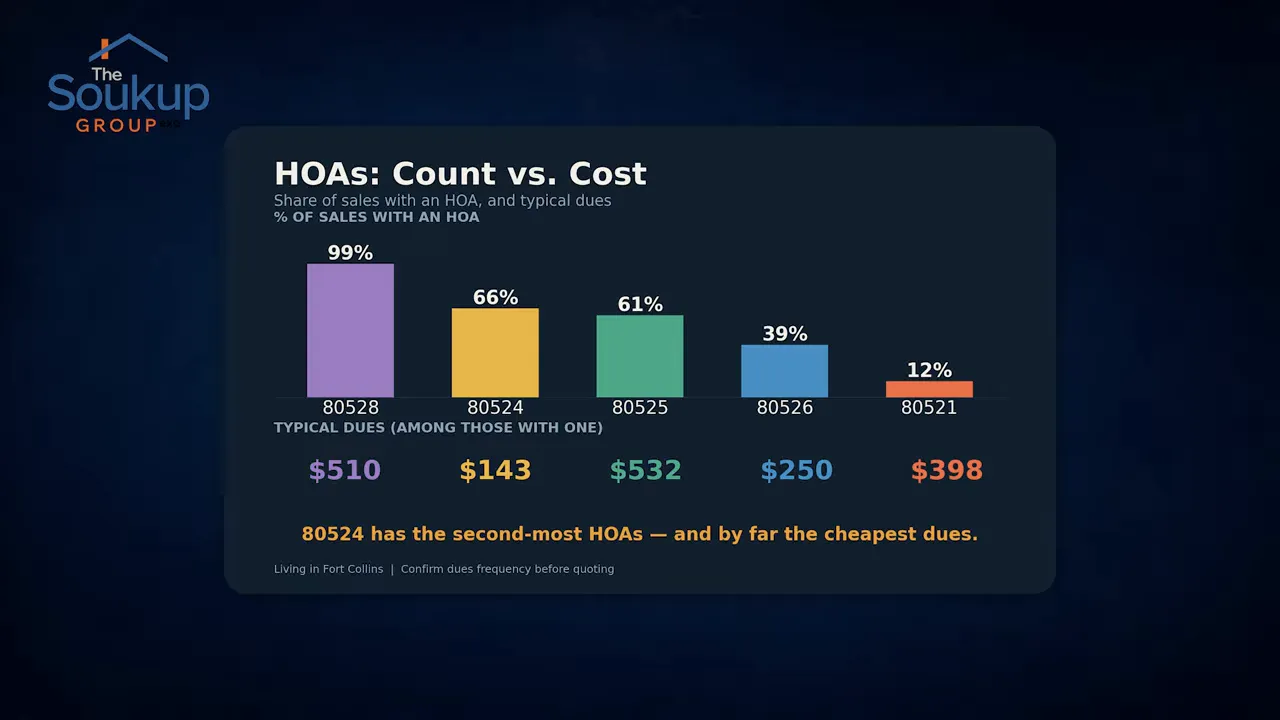
Ownership costs matter too. HOA prevalence is essentially universal in 80528 at 99% of sales. It is 66% in 80524, 61% in 80521, 39% in 80526, and just 12% in 80521. The important wrinkle is cost: 80524 HOA dues average about $143, much lower than roughly $530 in 80525 and $510 in 80528. Count and cost are two different things, so evaluate both.
Then there is Colorado gear. In 80528, the average home has 2.65 garage spaces, and 64% have a three-car garage or larger. In 80521, the average is 1.47 spaces, only 10% have a three-car garage, and 12% have no garage at all. Alley garages are charming until February, when your truck, bikes, skis, boat, and daily driver all need a place to go.
Fort Collins Market Resilience and Current Inventory
Appreciation is fun when everything goes up. Defense matters when rates go from 3% to 7% and markets cool off.
From the 2022 peak through the recent correction, 80525 had the shallowest maximum drawdown at just 2%. 80521 fell 3.3%, 80526 fell 5.2%, 80524 fell 7.7%, and 80528 fell 10.6%.
80525 is the sturdy, sleep-at-night option. It has a broad spread of home eras, 507 detached closings in the last 12 months, and a deep pool of buyers for different kinds of properties. The heavier drawdowns in 80524 and 80528 make sense because active builders compete directly with resale sellers through rate buydowns, incentives, completed basements, and closeout pricing.
That is not a reason to avoid new construction. 80528 was still the second-best per-foot appreciator. It simply means planning a longer hold, more like five to seven years, versus perhaps four to five years in the more stable 80525 market.
As of September 2026, 80524 had the most inventory at 3.19 months and the longest average market time at about 63 days. More supply means more leverage for buyers. 80526 was tightest at 1.7 months of supply, with homes moving in about 48 days and demand showing momentum.
80521 is the one worth watching. It is a small, thin market, with only 204 detached sales in the last 12 months. New listings and closed sales were down, which means less competition than there has been in years for the right west-side, walk-to-Old-Town house.
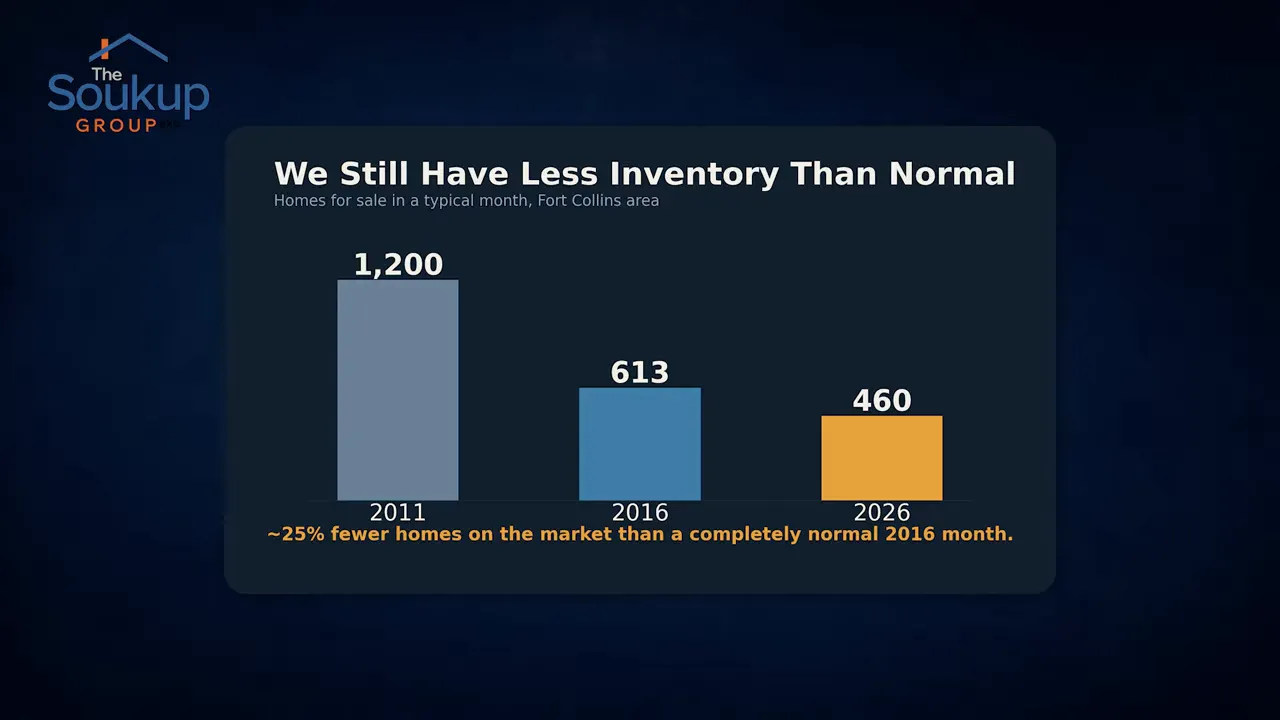
For the broader backdrop, Fort Collins gave back only about 3.6% from peak to trough during the Great Recession and recovered by 2011. A major university, hospital system, diverse employers, geographic constraints, and a lack of runaway supply all matter. Current inventory is higher than the frenzy years, sure, but still below a normal 2016 market and far below 2011 levels.
Relocating to Fort Collins: How to Choose the Right Area
Here is the straight answer on the best places to live in Fort Collins, based on what matters most to you.
- Choose 80521 for walkability, Old Town energy, character, trails, and mature neighborhoods. Expect smaller homes, smaller garages, older systems, almost no HOA burden, and the highest cost per square foot.
- Choose 80524 for northern new construction, the widest range of home ages, lower HOA dues, and more room to negotiate in the current market.
- Choose 80525 for a central, balanced, durable all-around option. It combines larger homes, strong per-foot value, a deep market, and the best recent resilience.
- Choose 80526 for foothills access, open space, established neighborhoods, mature trees, the biggest lots, and that 1980s and 1990s sweet spot. Just know it is built out.
- Choose 80528 for the most house per dollar, newer homes, three-car garages, and unfinished-basement flexibility. Budget for the HOA, expect a relatively smaller yard, and give yourself a longer ownership horizon.
The best places to live in Fort Collins are not decided by a leaderboard. Data narrows the search, but it does not make the decision. Drive the routes you will actually drive. Think through work, schools, trail access, your garage situation, the yard you want, and how long you expect to stay. That is how relocating to Fort Collins gets a whole lot clearer.
Relocating to Fort Collins or searching for a new construction home? We can help you compare neighborhoods, understand the local market, and find a home that fits your budget, lifestyle, and long-term plans.
Call or text (970) 893-3533 or book your FREE consultation today.
Frequently Asked Questions About The Best Places To Live In Fort Collins
Which ZIP code is the best all-around choice in Fort Collins?
80525 is the strongest all-around option in this comparison. It has a balanced mix of home ages, central access, larger homes, solid value per square foot, the deepest market, and the smallest recent price drawdown.
Where can I find new construction in Fort Collins?
Within Fort Collins city limits, 80524 and 80528 are the only ZIP codes with meaningful new construction activity. Recent new-build sales accounted for about 16% of 80524 transactions and 15% in 80528.
Which Fort Collins ZIP code has the best value per square foot?
80528 has the lowest rolling 12-month price per square foot at about $223. However, many homes include large unfinished basements, HOA participation is nearly universal, and lot sizes tend to be smaller relative to house size.
Which area is best for Old Town character and walkability?
80521 is the primary choice for older homes, mature trees, front porches, alleys, CSU proximity, Old Town access, the Poudre Trail, and foothill proximity. It also has the oldest homes and smallest garages in the city.
Read More: WHY EVERYONE IS LEAVING FORT COLLINS COLORADO IN 2026 (THE REAL REASONS)