
Fort Collins Townhomes & Condos: Is Now the Time to Buy?
There are 261 townhomes and condos for sale in Fort Collins right now. That's the most we've seen in any September going back to 2016. Six out of ten buyers who closed last month got the seller to pay something toward their closing costs. If you've been waiting for leverage, this is what it looks like: concessions, negotiation, price adjustments a little more favorable to the buyer.
I was born and raised here in Fort Collins and I've been selling real estate full-time since 2013. Whether you're renting and itching to buy, you own a townhome and you're wondering if now's the time to move up, or you're an empty nester thinking about downsizing, this blog is for you.
This is not the usual detached home market update. Today we're doing a townhome and condo deep dive for September 2026. We're going to talk about the market numbers, new listings, price drops, sold homes, concessions, HOA dues (the lows, the highs, the median), and a townhome versus a house side-by-side monthly payment comparison. If you own a townhome or condo here, or you're thinking about buying one, the HOA is where people get burned. Before you write an offer or put yours on the market, call, text, or email my team. We look at the HOA docs and tell you what the dues actually cover. The link's in the description. Whether you're three months out or three years out, we would love to be an asset on your team.
HOAs are funky, especially the ones that are aging. We've had clients hit with substantial special assessments. If you don't know what that is, that's another reason to give us a call. We can talk about reserves, balances, budgets. Those things are serious considerations because the HOA adds another variable to your monthly payment. We can try to help you avoid some of those townhome condo purchases that could be seeing a special assessment in the near future.
Table of Contents
- Fort Collins Townhome and Condo Market
- What Sellers Are Actually Giving Up
- The HOA Line: What You're Really Paying For
- Which Area Is Right for You: Townhome vs House
- Monthly Payment Breakdown
- Who Should Choose What
- What This Means for Buyers and Sellers
- Looking Ahead: Q4 and the Sweet Spot for Buyers
- Conclusion
Fort Collins Townhome and Condo Market
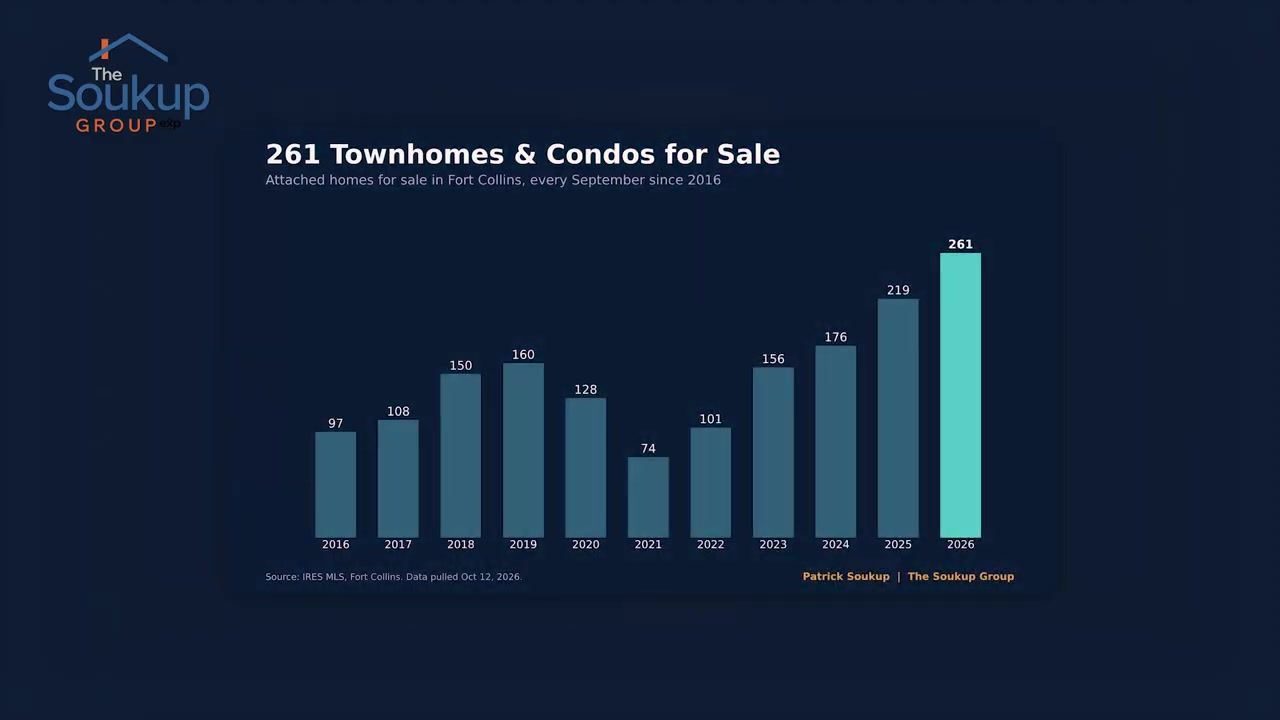
Let's jump right in. Homes for sale: 261, up from 219 last September. That's the highest September in our data going back to 2016. Back in 2021, there were only 74 homes for sale. Months supply: 4.7, up from 3.9 last year and 0.9 in September 2021. Months supply is essentially if nobody else lists, how long everything on the market is going to take to sell. Right now, roughly four to six months is a balanced to buyer market. So 4.7 means buyers have real leverage. The only month higher in our dataset is July 2025 at 5.0.
Closed sales: 57, down from 64 last September. Year to date, January through September, 526 versus 535. Actually relatively flat. Under contract homes: 47, down from 56. Lower pendings now means fewer closings in October and early November. New listings: 78, down from 87, but year to date 907, the most new listings January through September dating back to 2016. Supply is coming from more sellers, not necessarily fewer buyers.
Median days on market: 66, about the same as last year at 64. But back in September 2021, it was only 26. Median price: $385,000, down from $437,500. That's 12%, and that's a scary looking number, but you're not going to want to panic over one month. Fifty-seven sales is a small sample and the mix changes month to month. The number I truly trust the most is price per square foot. September: $268 versus $275 last year, down only 2.5%. The year-to-date average is $267 versus $287 in 2023, down 7%. From the peak, January through September average was $305 a foot in 2023. Now it's $267. That's roughly a 12% drop off the high.
If you own a townhome and you're wondering what yours is worth in this market (not the Zillow number, the real one), shoot us a text or email. We can dive into the dynamics, what you've done to the place, what comparables are selling for, and shoot you straight.
What Sellers Are Actually Giving Up
The headline numbers don't tell you how much sellers are actually giving up. The concessions do. Stick with me. Eighty-four Fort Collins attached listings hit the market in September. The median list price was $399,700. The median size of that home was 1,467 square feet. The median year built: 2003. Thirty-five of 84, about four in ten, are one-story ranches. That matters a lot because a lot of people look at townhomes and condos as an opportunity to downsize from their large detached house. Eleven of 84 are builder listings.
Status update as of when I pulled the data, October 12th: 61 were still active, 20 already had sold or are under contract, which is about one in four within four to six weeks. For comparison's sake, detached in September: new listings, 69 of about 220, or about one in three, were under contract or sold. Price changes: 111 townhomes or condos had a price change in September. Context: 111 versus 261 is roughly four in ten listings adjusted their price in just one month, which is actually less than the detached homes, which had 239 against 493. So roughly half of the detached product had price reductions compared to only four in ten. Not a huge difference, but something to take note of.
Homes that sold: 56 closings in September. The median sales price was $382,500 against a median list price of $395,000. The median sold to list is 98.7%. Thirty of 56 homes sold below list. Eight sold 5% or more below list. Let's look at some price bands. Thirteen sales under $300,000, 20 between $300,000 and $400,000, 13 at $400,000 to $500,000, 8 at $500,000 to $600,000, and 2 actually over $1 million. Bedrooms: 26 two-bedrooms and 20 three-bedrooms. Fourteen of the 56 paid cash. Ten of the 56 were builder sales.
But let's look at concessions because I think that's the real story. Thirty-four of 56 sales, 61%, had a seller concession. The median concession: $5,000, or about 1.1% of the price. The largest was $15,750. If you take into consideration list price to sales price and concessions, net of concessions, the median buyer paid about 98.1% of the list price. For comparison's sake, detached had 63 of 115 sales, or 55%, with a concession, with the median concession at $8,660, with the largest concession at $65,000.
Just so you guys understand what a concession is, essentially it's a seller contributing funds at closing so that the buyer can either have less closing costs or pay down their interest rate. It's a strategy that a lot of buyers are using today. A lot of the time right now, the smarter play isn't necessarily beating the seller up on price. It's asking for a credit or a concession to buy down your rate. For number's sake, on a $346,000 loan at today's rates, every quarter of a point is anywhere between $50 to $60 a month in savings. So it's real savings. If you want to understand what a concession versus a price reduction could do for you on your payment, that's a ten-minute conversation. That's a call, text, or email, and we can get you connected with a great lender. Murphy Willock Group is somebody who we work a ton with, and I think they do a great job of explaining the differences, pros and cons, and what your desires are.
The HOA Line: What You're Really Paying For
I think this is probably one of the most important conversations when we are discussing a condo or townhome. The HOA line is what really makes or breaks a townhome purchase. Let's look at what people are actually paying. We're going to look at the low, the high, the median, and the average. Sold in September, 56. The low: $12.50 per month. High: $579 per month. Median: $340 per month. And the average: $296.
For new listings that came onto the market, the low is $49 per month. There were 84 new listings in September. $563 is the high, $368 the median, and $347 the average. What about those that had price changes in September? One hundred eleven of them. $49 per month on the low side, $700 per month on the high side. And that makes a lot of sense. If you have a $700 a month HOA, that's a real consideration for anyone who's buying a home. Median: $344 per month and average $324.
You can see based off of the ones that have closed comparatively to the new listings and the ones that had price changes, we're seeing a little bit higher HOAs are sitting longer, having to do price reductions and really making a compelling reason for that buyer to make a move. Interestingly enough, some of the lower end HOAs are in the newer developments. A big reason that could be is because some of those HOA expenses, the amenities that are being covered and protected, are actually built into your metro district. So that's an encompassing picture that we got to look at on a case-by-case study. Some of the other ones, actually the older ones, have higher HOAs because they've got deferred maintenance that they got to keep up with. Either you're going to have a special assessment, you're going to have an increase in dues to pay for some of those. So you really got to look at the product that you're buying.
I think this is really interesting because the lowest HOA units sold for more money. It's simple. You're either paying money on the price or the HOA, but ultimately you only have so many dollars of income coming in each month and you got to focus on what you can do. Sales with an HOA of $200 per month or less had a median price of about $500,000 and there were 15 sales. $300 to $400 per month HOA, about $363,000 and 22 sales. Over $400 per month, about $347,000 and 11 sales. Those are really things to take into consideration because people are seriously looking at the HOA. If your HOA is popping up, you're not going to be able to increase the price because people again only have so much money to pay per month.
Some of these HOAs on the newer products are covering less. The roof insurance, the structure exterior, those could be now covered through yourself, your own insurance policy. High HOA products, they are typically covering the roof. So you got to understand what type of policy you have, HO3 or HO6 condo or townhome.
Before I get too excited, because I do think it is important what the HOA covers, a great personal story: I have only ever bought one personal condo for myself and it was a selfish desire. I wanted to live in the place. I didn't want to have to do any exterior maintenance, and I was willing to pay an HOA. It was a 900-square-foot, one-bedroom condo, and the HOA when I bought it was $160. If you're interested and you want to do something like getting on the HOA board, it is important at least paying attention because the dynamic of who lives in that community matters. I will say the one that I was at, there was a little bit older demographic and they wanted everything done for them. So they actually voted on bringing in a TV service each month that popped my $170 per month up to like $215 per month. I was like, I don't use cable TV. I use YouTube TV. So now I'm paying for a cable service that I'm not necessarily even using.
Understanding what an HOA covers, the dynamics of how they vote these things in, whatever's voted in can be voted out. But it is a little bit harder removing those because you do typically sign contracts when you're at a higher unit count because you get a commercial deal with Comcast or CenturyLink, whoever that might be. Also understand that they can increase not just based off of expenses or deferred maintenance, but because of what the community wants to vote on and bring into the fold.
Understanding what all the HOA covers is extremely important because you might have a $500 a month HOA, but it's covering gas, electric, water, trash, and maybe even internet. The only additional expense that you might have is your principal interest, property taxes, and insurance, and you don't have any other utilities. So you do have to look at it as an entire package and understand what the HOA covers.
This is also important to understand: a $340 a month HOA at 7.4% is the same payment as about $49,000 of extra mortgage. Lenders count it the same way when you qualify. So if you have a $340 a month HOA, that does mean that you are purchasing a $50,000 less property based off your qualification standards. If you're looking at a specific complex or want to know what the HOA is doing in a specific area, send me the address. We're happy to dig in and find out what we can and send that on to you.
Which Area Is Right for You: Townhome vs House
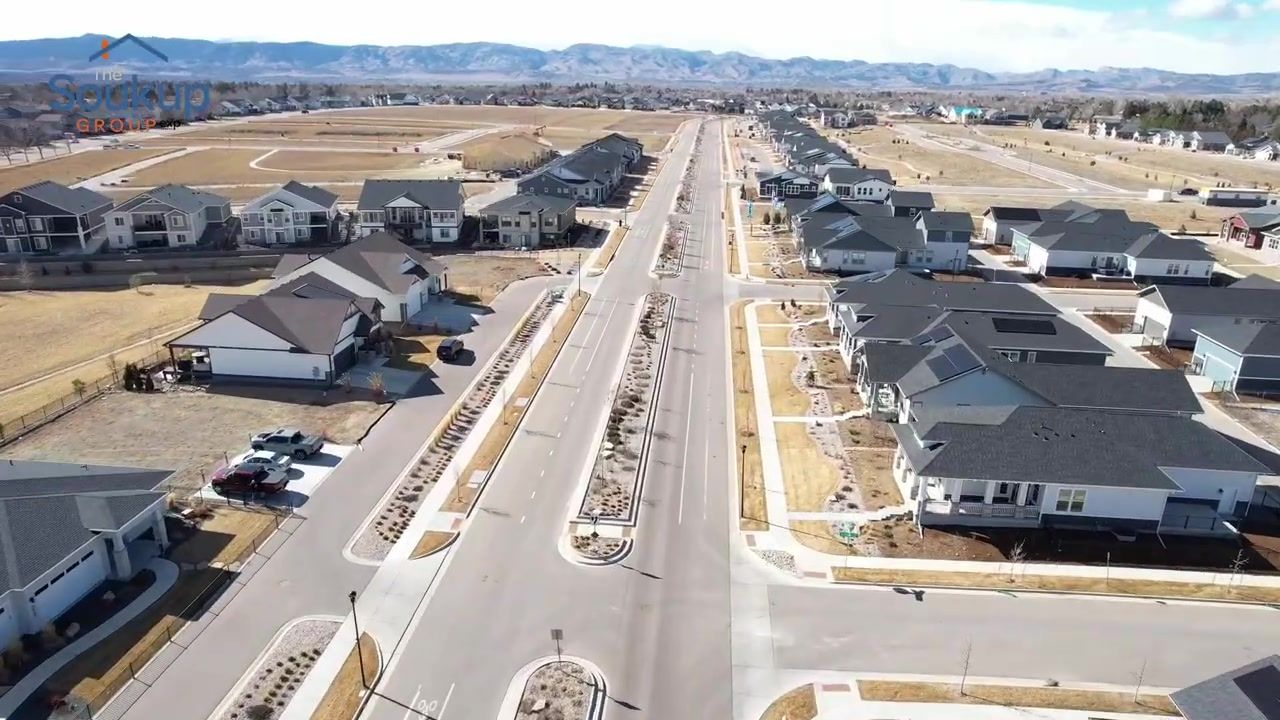
Which one is the better buy right now, the townhome or the house? The answer may have caught me off guard, and I've been doing this for a long time. Leverage: attached product, 4.7 months of supply versus detached, 3.3. Attached days on market: 66 versus detached, 48. Townhome sellers are under more pressure.
Price per square foot is basically the same. September median: $268 a foot for attached versus $265 for detached. But what's crazy is the median townhome is $385,000 and the median house is $605,000. But that's mostly because the house is going to be much bigger. The median sold size townhome condo is 1,500 square feet versus the detached product, which is 2,560 square feet. Understand what total square footage includes. This does include basements and more detached homes are going to have them comparatively to the attached product. So price per square foot detached is going to be a bit pricier.
But I think the direction is different and worth looking at. The attached price per square foot January through September averaged $305 in 2023 to $267 in 2026, a 12% drop off the high. Detached, January through September averaged $246 in 2023 and it's $255 in 2026, up about 3%. Even though the median price fell from $624,000 to $604,000, that's a mixed problem. Smaller homes are selling, but each foot is costing a bit more.
If you're torn between a townhome and a house, that's exactly the conversation that we have every single week. Give my team and I a call. We can talk you through it and kind of lay it out side by side. But that's what we're going to do right now.
Monthly Payment Breakdown
This is the part you've probably been waiting for. Median townhome versus median house, 10% down, 30-year fixed at a 7.4% interest rate. That's the interest rate we're seeing. You can probably get a little bit lower if you buy it down, maybe a little bit higher depending on where you're going. But that was as of October, right around October 8th, October 12th time period.
Attached product, townhome condo: $385,000 median price. Detached: $604,950. Down payment, 10%: $38,500 on a townhome condo or $60,495 on a detached home. The loan amount at 10% down: $346,500 versus $544,455. Principal and interest alone, pretty significant difference because your loan's about $200,000 less. $2,399 for a condo townhome, $3,770 a month for a detached product.
Property taxes, and this is an estimation, you're going to definitely want to verify this, especially if you're in a metro district versus not: $176 a month for a townhome condo, $277 or so a month for detached. Insurance, and this is an HO6, HO3 policy. You got to understand the difference because this could fluctuate a bit. $60 a month for townhome condo, $200 a month for a single-family detached home.
Because you're only putting 10% down, you're going to have that lovely thing called private mortgage insurance. One thing, and I've got a quick story on this: my wife and I, we've got a fantastic lifelong story. We've been together for about 20 years, but we got married young and actually got divorced. Clearly it was an amicable divorce because we are remarried, but we stayed friends and actually business partners during this time. We owned a house together that we bought in 2013. We got divorced in, I think, 2015 or so, but only about three or four years later, 2016, '17, I actually sent my ex-wife at the time a text and I said, hey, listen, you might want to look at getting your house reappraised because your PMI could drop off, which is $100 to $200 per month. That's a significant amount, especially for a single person at that time.
What it looks at is if it gets reappraised and you have a greater value, a greater 80% loan-to-value. So if you're at 78, 77, great. If you still only have 10, 12, 15% equity in the home, that PMI is going to remain, but you can get that reappraised and you will have to pay an appraiser to do that. But that's like $600, $700 and the payback is three, four months depending on what your PMI is. It's a great investment. It's a conversation that we have. We can look at what the market's doing at a CMA level. We can provide comps and comparables to appraisers to help you through that process. We can't guarantee anything because appraisers are somewhat of a wild card these days, and it does come at a $500 to $600 cost. But we can help you through that and get you to a point where maybe you can save a couple hundred dollars a month.
Side note, jumping back in: PMI for a townhome condo, $101 a month versus a detached home, $160 a month. And here is where there's a pretty significant difference. HOA, townhome condo: $340 a month. Detached product: $50 a month. You add all those things together, your total monthly payment, townhome condo: $3,077 per month versus a detached product of about $4,456 per month. That's a $1,379 a month gap. Plus about $22,000 less cash for the down payment.
But pause. If you're an economist, an engineer, somebody who loves math, accounting, whatever that might be, the per square foot of living space, the actual house, detached house is cheaper monthly. A townhome at $3,077 per month, about 1,500 square feet is $2.05 per square foot per month comparatively to the house of $4,456 per month, but getting 2,560 square feet. So you're only paying $1.74 per square foot per month. The HOA definitely is a big reason there. You're not getting a cheaper square foot. You're really buying fewer square feet and paying someone else to handle the outside maintenance.
Right now, interest rates are really mattering a whole lot more. Late August, Freddie Mac average was like 6.66%. As of like October 8th, 12th, 7.4%. On the townhome loan, that's an increase of about $172 more per month. On a house, $271 more per month.
Who Should Choose What
Who does the townhome win for?
- First-time homebuyers who want to stop renting
- Downsizers who want to quit shoveling the snow or mowing
- People who travel , lock-and-leave people who want to have a place to come, call their house, but not have to deal with or be concerned about that exterior maintenance side of things
What about the house? The houses are for people who need more space and can carry the payment. I think it's important to understand those numbers we just looked at side by side are, of course, estimates. Only taxes, insurance, PMI, HOA vary by property. Probably the best place to talk to for somebody on that is talking to a lender. Understand the real numbers on a property-by-property basis. We can help you, but we can't get you all the way there. But we can connect you with a very trusted, reliable resource in a lender.
What This Means for Buyers and Sellers
Let's bring it home. If you're buying or selling a townhome in Fort Collins this fall or winter, here's exactly how I'd play it.
If you're buying , there is negotiation room. 4.7 months of supply, six in ten sales with concessions, four in ten listings changed price in September. If you're me, I'd ask for the credit concession, not just the discount. With rates up, a concession aimed at the rate can beat a lower price. If you're looking at a builder product, ask what the incentives are. Push what the incentives are. I would say definitely want to talk with us on a buyer agency agreement for representation on a new build because we are pushing hard against builders right now and getting you the most bang for your buck.
If you're a downsizer, about four in ten attached listings are one-story ranches, a great downsize option. Entry point: 13 townhomes or condos sold for under $300,000 in September. If you're looking at a detached product, zero homes sold for $300,000 or less. Fair to be honest, attached prices have been softer than detached for three years. If you're buying a townhome strictly as an appreciation play, go in eyes wide open. Buy it because it fits your life and your budget, not necessarily an investment.
If you're selling a townhome or condo , price it right from day one. Median days on market is 66. The listings that cut price in September had been sitting on a median of 80 days. Expect to talk concessions. 61% of September sales had one. The median was $5,000. Build it into your plan instead of being surprised by it.
Have your HOA story ready. Buyers are comparing dues. $340 is the median HOA. You want to pull the budget, the reserves, what the dues cover before you list and can express the value of what that HOA brings. Understand, is it an HO3 or HO6 policy? Know your competition. 261 attached homes for sale and builders are cutting prices too. Understand who you're competing against.
If you're moving up, you're selling the townhome into a 4.7 months of supply. You buy the house in a 3.3 months supply. The house side is a bit tighter. So you've got to line up your plan if you're trying to sell and then buy. You're going to want to plan and schedule and strategize when you list. If you're thinking about selling that townhome or moving up or downsizing into one, call, text, or email me and my team. We'll talk you through both sides of that move.
Looking Ahead: Q4 and the Sweet Spot for Buyers
What's coming down the pipeline for townhomes and condos this fall and winter? This is based on the typical September to fall pattern from 2021 to 2026. October closings, we're going to expect about 47. September pendings were only about 47, so we should see some spillover from August that were under contract. Contracts these days are really between 30 to 45, 50 days, so some pendings from August into October and then close in October.
Inventory about 246 in October, drifting to about 211 by December. Months of supply about 4.4 through November, but drops down to about 3.6 by December. Seasonally what this means is fewer listings over the holidays. But the sellers who stay on the market through December are usually very motivated. Q4 can be a sweet spot for a buyer who's ready to make the move.
Rates are the wild card here. We went up from 6.66% in August to 7.4% in about six weeks. If they ease, competition will come back and come back fast.
Conclusion
The Fort Collins townhome and condo market in September 2026 is giving buyers leverage they haven't had in years. With 4.7 months of supply, 61% of sales including seller concessions, and prices down 12% from their 2023 peak, this is what a buyer's market looks like. The median price of $385,000 is still holding relatively steady on a per-square-foot basis, down only 2.5% year over year, which tells me the headline drop is more about mix than panic.
But here's the thing: if you're buying, you need to understand the HOA. That $340 median monthly fee is the same as carrying about $49,000 more mortgage. Lower HOA units sold for more money because buyers only have so many dollars to spend each month. If you're selling, price it right from day one, expect to negotiate concessions, and have your HOA story ready. Buyers are comparing dues and they're doing the math.
Whether you're a first-time buyer looking for an entry point under $300,000, a downsizer who wants a one-story ranch, or someone moving up from a townhome to a house, the strategy matters. If you want to talk through your specific situation, whether you're three months out or three years out, call/text me at 970-893-3533 or book a FREE consultation here. We can walk you through the numbers, pull the HOA docs, and help you make the move that fits your life and your budget.
FAQ
Are Fort Collins townhome prices going to keep falling?
The median price is down 12% from last September, but price per square foot is only down 2.5%. The headline drop is mostly about mix (smaller units selling). From the 2023 peak, we're down about 12% on a per-square-foot basis. Attached prices have been softer than detached for three years. If you're buying strictly for appreciation, go in eyes wide open. Buy because it fits your life and budget.
How much should I expect to pay in HOA fees?
The median HOA in September was $340 per month. The range was $12.50 to $700. Lower HOA units (under $200/month) had a median price around $500,000. Higher HOA units (over $400/month) had a median around $347,000. Buyers only have so many dollars per month, so higher HOAs mean lower purchase prices. Understand what your HOA covers: some include roof, structure, insurance, and utilities. Others cover less and you pay more out of pocket.
Should I ask for a price reduction or a seller concession?
With rates up, a concession aimed at buying down your rate can beat a lower price. On a $346,000 loan at 7.4%, every quarter of a point is $50 to $60 a month in savings. Sixty-one percent of September sales had a concession, with a median of $5,000. The largest was $15,750. If you're looking at a builder product, push hard on incentives. We're getting buyers the most bang for their buck on new builds right now.
Can I remove PMI after I buy?
Yes. If you put down less than 20%, you'll pay PMI. But if your home value increases and you reach 20-22% equity, you can get a reappraisal and remove it. That's $100 to $200 per month in savings. The appraisal costs $500 to $600, but the payback is three to four months. We can provide comps to help the appraiser, but we can't guarantee the outcome. It's a conversation worth having if you think you've gained equity.
Is now a good time to downsize into a townhome?
Four in ten new September listings are one-story ranches, which is great for downsizers. You've got 4.7 months of supply, which means buyer leverage. Thirteen townhomes sold under $300,000 in September. Zero detached homes sold under $300,000. If you're selling a house and buying a townhome, you're selling into a 3.3 months supply (tighter) and buying into a 4.7 months supply (more room to negotiate). Line up your plan and timing. We can help you strategize both sides of that move.
What happens to inventory in Q4?
Inventory typically drops from about 246 in October to 211 by December. Months of supply falls from 4.4 to 3.6. Fewer listings over the holidays, but the sellers who stay on the market through December are usually very motivated. Q4 can be a sweet spot for a buyer who's ready to move. Rates are the wild card. If they ease, competition will come back fast.
Living in fort collins x The Soukup Group
Expert market analysis and Northern Colorado lifestyle insights from the region's top 1% authority.

Stay ahead of trends
FORT COLLINS AND BEYOND Market UPDATES.
Go beyond the headlines with our deep-dive analysis into local real estate trends and economic shifts. We translate complex market data into actionable advice for homeowners and investors.