
When we are moving to Fort Collins, it is easy to focus on the listing price and the mortgage calculator result. A $625,000 home can look like a simple equation: put 10% down, get a loan, make the payment, done.
That is not how buying a house actually works. The down payment is only one part of the cash needed before closing. The mortgage payment is only one part of the monthly ownership cost. Then come inspections, escrow funding, insurance, taxes, private mortgage insurance, furnaces, roofs, sprinklers, water heaters, and all the other things that do not show up on Zillow.
For anyone moving to Fort Collins, the goal is not to stretch to the maximum number a lender approves. The goal is to buy a home that fits comfortably into real life, with money left over after closing.
How Much Does It Cost to Buy a Home in Fort Collins?
For moving to Fort Collins, we are using a $625,000 detached single-family home as the working example. That has been around the median Fort Collins sales price over the last several years, even after the rapid price growth earlier in the decade settled into more of a plateau.
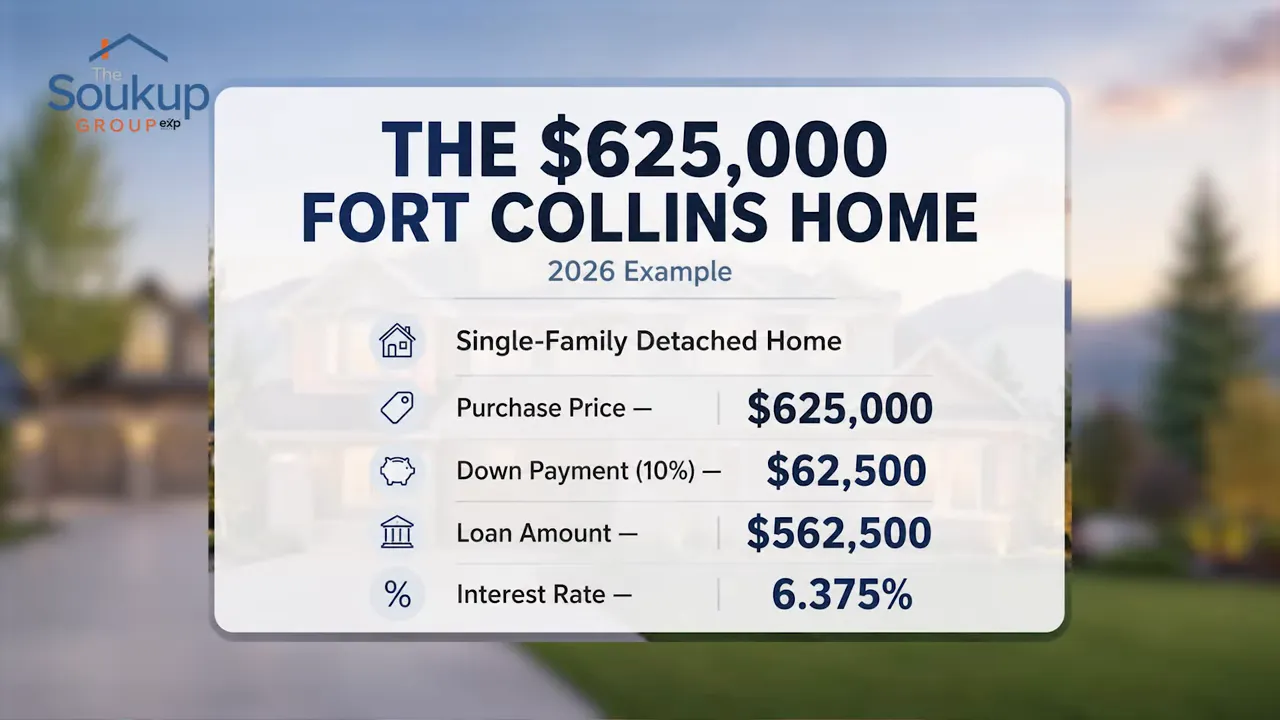
For this scenario, we assume:
- Purchase price: $625,000
- Down payment: 10%, or $62,500
- Loan amount: $562,500
- Interest rate: 6.375%
- Loan type: 30-year fixed mortgage
A 10% down payment is not the only option. Depending on the loan program and borrower profile, some buyers may qualify with 3%, 3.5%, 5%, or even no money down in specific situations. But putting less down does not mean the overall purchase is cheaper. It often means private mortgage insurance and a larger loan balance become part of the equation.
Most importantly, when moving to Fort Collins, we should never confuse a down payment with the total amount needed to buy.
Upfront Cash Needed Before Buying a Home in Fort Collins
One of the most common misunderstandings is thinking that $65,000 in savings means we are ready to put 10% down on a $625,000 house. Technically, the $62,500 down payment is covered. Realistically, that would leave almost nothing for the rest of the process or for life after closing.
Here is what can require cash before or at closing.
Earnest Money
In Northern Colorado, earnest money commonly lands around 1% of the purchase price. On this example, that is about $6,250. It is generally credited toward the money owed at closing, so we are not counting it twice. But it does need to be available early. An accepted offer on a Sunday night can mean several thousand dollars is due within just a few days.
Inspections and Due Diligence
A general home inspection in Northern Colorado may run about $500 to $700. Add a sewer scope at roughly $150 and a radon test at roughly $150, and a typical inspection package can land between $800 and $1,000.
Sometimes an inspection calls for another professional. That may mean a structural engineer, roofer, HVAC contractor, mold evaluator, or water intrusion specialist. We do not need every possible inspection on every house, but we need room in the budget for a concern that comes up.
Spending $1,000 to investigate a home and deciding not to buy it can feel frustrating. Spending $1,000 to avoid a $625,000 mistake can be a very good investment. This is especially important when moving to Fort Collins from another market and learning how different home ages, lots, irrigation systems, and climate considerations can affect a property.
Appraisal
For a financed purchase, the lender will generally require an appraisal. A reasonable estimate is $600 to $800, with $700 being a useful planning number. If we order an appraisal and the deal does not close, that is still a cost we may be responsible for.
Fort Collins Closing Costs Explained
There is no universal answer to the question, “What are closing costs?” Generic answers like 1% or 2% do not tell us enough, because people use the phrase to describe entirely different expenses.
The simplest way to understand the money is to separate it into four buckets.
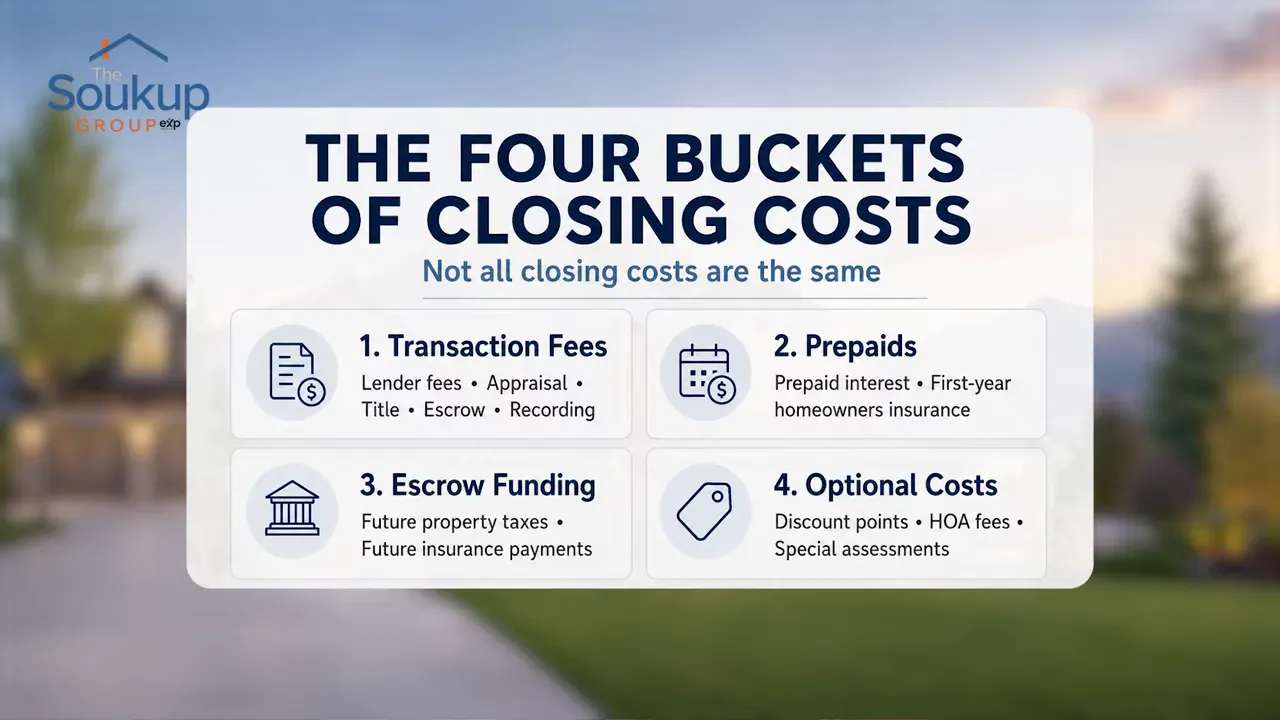
- Transaction fees: Lender fees, appraisal, title and escrow fees, and recording costs. These are the charges for completing the transaction.
- Prepaids: Prepaid mortgage interest and the first year of homeowners insurance. We are paying in advance for items we will receive.
- Escrow funding: Money collected for future property taxes and insurance. It affects cash to close, but it is not a fee.
- Optional or property-specific costs: Discount points, HOA transfer charges, working-capital contributions, and special assessments.
For people moving to Fort Collins, this breakdown matters because the actual timing of closing can change the numbers. A buyer closing near the beginning of the month may have more prepaid interest due than a buyer closing near the end of the month. HOA costs, insurance premiums, tax districts, and seller concessions can also shift the final total.
Three Real-World Closing Examples
A cash buyer purchased a nearly $1 million property and had only $377.25 in buyer-side settlement charges: a closing fee, extended title coverage, deed recording, and document fees. That is low because there was no lender, no lender fees, no mortgage interest prepayment, no lender-required appraisal, and no lender escrow account.
That does not mean cash buyers have no costs. Most people still insure a high-value home, and an insurance company may require the first annual premium upfront. On a property around $1 million, that insurance cost could be roughly $4,800 to $5,800 even if it never appears on the settlement statement.
A traditionally financed $1.1 million purchase with 20% down showed roughly $2,800 in transaction fees. But the buyer also brought prepaid interest, insurance funds, and property tax escrow funding. Those are real cash needs, even if they are not all fees.
The real question is not simply, “How much are closing costs?” The better question is, “What exactly are we paying for?”
Are Mortgage Discount Points Worth It?
A larger down payment does not automatically mean a low amount of cash leaving the account at closing. One real Northern Colorado buyer purchased a $775,000 home, put almost 50% down, and still paid nearly $13,800 in discount points.
Points are not automatically good or bad. They are a strategic decision to spend more money now in exchange for a lower interest rate and lower future payment. Before buying points, we need to know:
- How much does the interest rate decrease?
- How much does the monthly payment decrease?
- How many months will it take to recover the upfront cost?
- How long do we expect to keep the mortgage?
If the break-even point is five years but we refinance in two years, buying points may not have been the best use of cash. If we are comfortable with the rate, intend to keep the loan for a long time, and have a long ownership horizon, it may make perfect sense.
When moving to Fort Collins, seller concessions can also be worth discussing. A $10,000 purchase-price reduction does not change a large loan payment dramatically. That same $10,000 used toward a rate buydown or allowable closing costs could have a more meaningful impact on monthly affordability. The correct answer depends on the numbers, our cash reserves, and our plans for the property.
Buyer Agent Commission Changes in Colorado
Buyer agent compensation has become a much earlier conversation since the NAR settlement changes. Written buyer agreements matter. Compensation is established clearly, and it is negotiable.
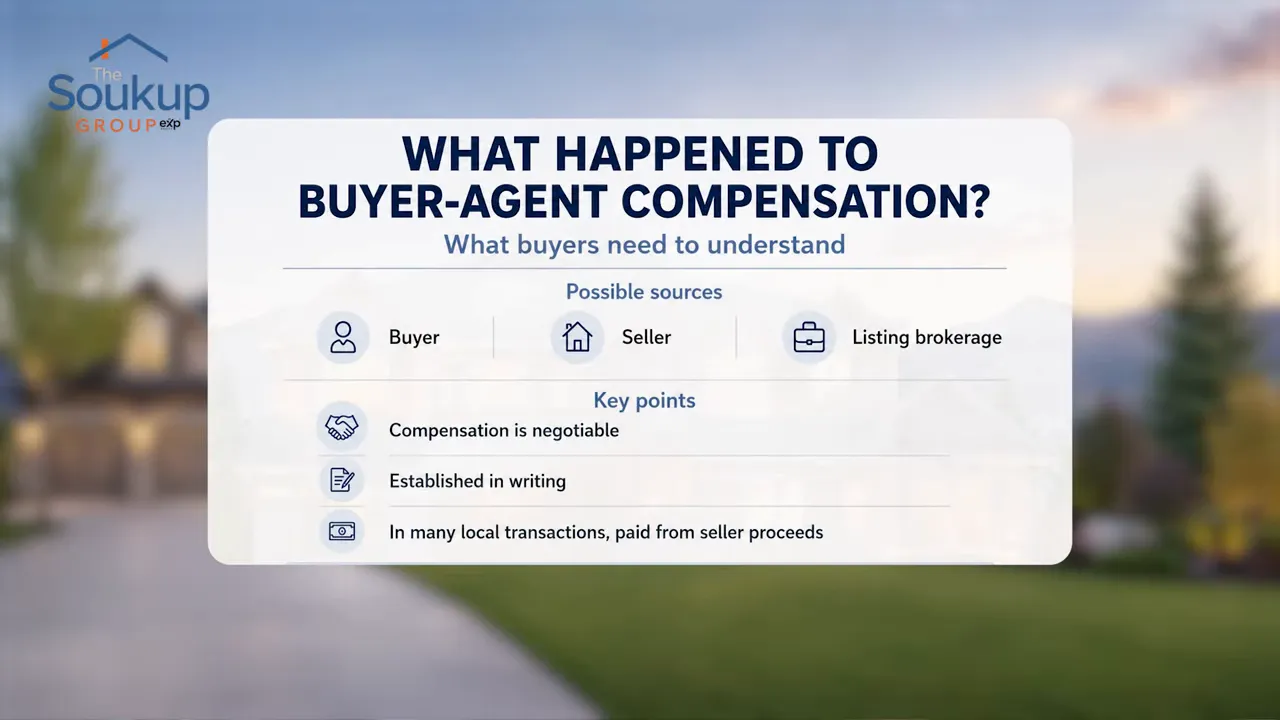
In Colorado contracts, there are generally three possible sources for buyer agent compensation:
- The buyer
- The seller
- The listing brokerage through a separate agreement
In our real-world Northern Colorado experience, buyer agent compensation has continued to be negotiated from the seller’s proceeds in buyer transactions since the changes took effect. That does not mean a seller is required to do it. It means the economics have not changed as dramatically as some headlines suggested.
Before getting emotionally attached to a house, we need answers to three questions: How is our brokerage being paid? What does our agreement say? What happens if the seller does not agree to pay?
The True Monthly Cost of Owning a Home in Fort Collins
For our $562,500 loan at 6.375% on a 30-year fixed mortgage, principal and interest come to about $3,509 per month. That number is not the total cost of ownership.
We still need to add taxes, insurance, and PMI:
- Principal and interest: $3,509 per month
- Property taxes: about $297 per month
- Homeowners insurance: about $260 to $390 per month
- Private mortgage insurance: about $234 per month in this example
That brings the actual monthly housing cost to roughly $4,300 to $4,430 per month before HOA dues.
Property taxes vary by property and taxing district, so two homes with the same sales price may not have the same tax bill. Insurance should not be selected based only on the lowest premium either. In Northern Colorado, deductibles, wind and hail provisions, and roof coverage can matter significantly.
Anyone moving to Fort Collins should account for these numbers before deciding what price range feels comfortable. The online calculator payment may be $3,500, but the monthly housing reality can be much higher.
Ongoing Home Maintenance and Ownership Expenses
A common planning rule is to reserve about 1% of a home’s value annually for maintenance and long-term capital replacements. On a $625,000 house, that is $6,250 per year, or about $521 per month.
We are not saying the house will cost exactly $521 every month. Some months may be quiet. Then the water heater fails, the furnace needs a major repair, or the roof needs attention.
It helps to separate these expenses into two categories:
- Regular maintenance: Furnace and AC service, sprinkler maintenance, lawn care, gutters, snow removal, and tree trimming.
- Capital replacements: Roof, furnace, air conditioner, water heater, windows, sewer line, and major appliances.
A newer home and an older home should not necessarily have the same reserve strategy. Risk tolerance matters. Property condition matters. But every homeowner needs a plan.
Add that $521 monthly reserve to the $4,300 to $4,430 housing payment, and we are at approximately $4,800 to $4,900 per month, before utilities, HOA dues, furniture, moving expenses, and all the random purchases that appear right after getting the keys.
That is the bigger conversation when moving to Fort Collins. Buying the house and comfortably affording the house are two completely different things.
Total Cost of Buying a $625,000 Home in Fort Collins
Here is the straightforward summary for our example.
- Purchase price: $625,000
- Down payment: $62,500
- Loan amount: $562,500
- Earnest money: approximately $6,250, credited at closing
- Inspections: approximately $800 to $1,000
- Appraisal: approximately $600 to $800
- Total estimated cash needed for a straightforward 10% down purchase: roughly $70,000 to $76,000
- Monthly housing cost before HOA: roughly $4,300 to $4,430
- Monthly ownership budget with maintenance reserve: roughly $4,800 to $4,900
These are not guarantees. Seller contributions, points, insurance pricing, escrow funding, property taxes, and HOA expenses can move the numbers in either direction. But this is a much more realistic picture than assuming a $62,500 down payment and a $3,509 mortgage payment are the whole story.
Moving to Fort Collins can still be an excellent long-term decision. Homeownership provides stability, pride of ownership, and principal paydown over time. Fort Collins remains a desirable place to live, and the long-term outlook is compelling for buyers who plan to stay for five to 10 years or more.
At the same time, if we expect to be here for only two or three years, renting may be the smarter and less expensive option. The best decision is the one that fits our lifestyle, timeline, cash reserves, and comfort level, not just the maximum loan amount available.
When moving to Fort Collins, the last thing we want is to become house rich and cash poor. Buy the home that works after the inspection, after closing, and after the furnace decides it has had enough.
Planning on moving to Fort Collins? Whether you're buying your first home, relocating from out of state, or trying to understand the true cost of homeownership, I'm here to help. Call or text me at (970) 893-3533 or book your FREE consultation today to create a personalized relocation plan and find the right home with confidence.
FAQs About Buying a Home in Fort Collins
How much cash should we plan for when moving to Fort Collins and buying a $625,000 home?
With 10% down and no major rate buydown, a realistic planning range is roughly $70,000 to $76,000. That includes the down payment plus inspections, appraisal, lender and title charges, prepaids, insurance, and escrow funding. We should also keep reserves after closing rather than emptying the bank account to buy the home.
Is earnest money an extra cost on top of the down payment?
Usually no. Earnest money is generally credited toward the money owed at closing if the transaction closes. But it is money we need to access early in the contract process, often within days of having an offer accepted.
What is the real monthly cost of a $625,000 Fort Collins home?
In this example, principal and interest are about $3,509 monthly. After estimated taxes, insurance, and PMI, the cost is roughly $4,300 to $4,430 before HOA dues. With a 1% annual maintenance reserve, a more complete ownership budget is about $4,800 to $4,900 per month before utilities and other household expenses.
Should we buy mortgage points?
It depends on the break-even calculation. We need to compare the upfront point cost with the monthly savings from the lower interest rate, then consider how long we expect to keep the loan. Points can be useful for a long-term mortgage, but they are not automatically the right choice for every buyer.
Do sellers still pay buyer agent compensation in Colorado?
Compensation is negotiable and should be clearly addressed in a written buyer agreement. It may be paid by the buyer, seller, or listing brokerage through a separate agreement. In local transactions, seller-paid buyer agent compensation has continued to be commonly negotiated, but it is not guaranteed and should be discussed before writing an offer.
Read More: MOVING TO FORT COLLINS: WHAT $500K, $750K, AND $1M ACTUALLY BUY